
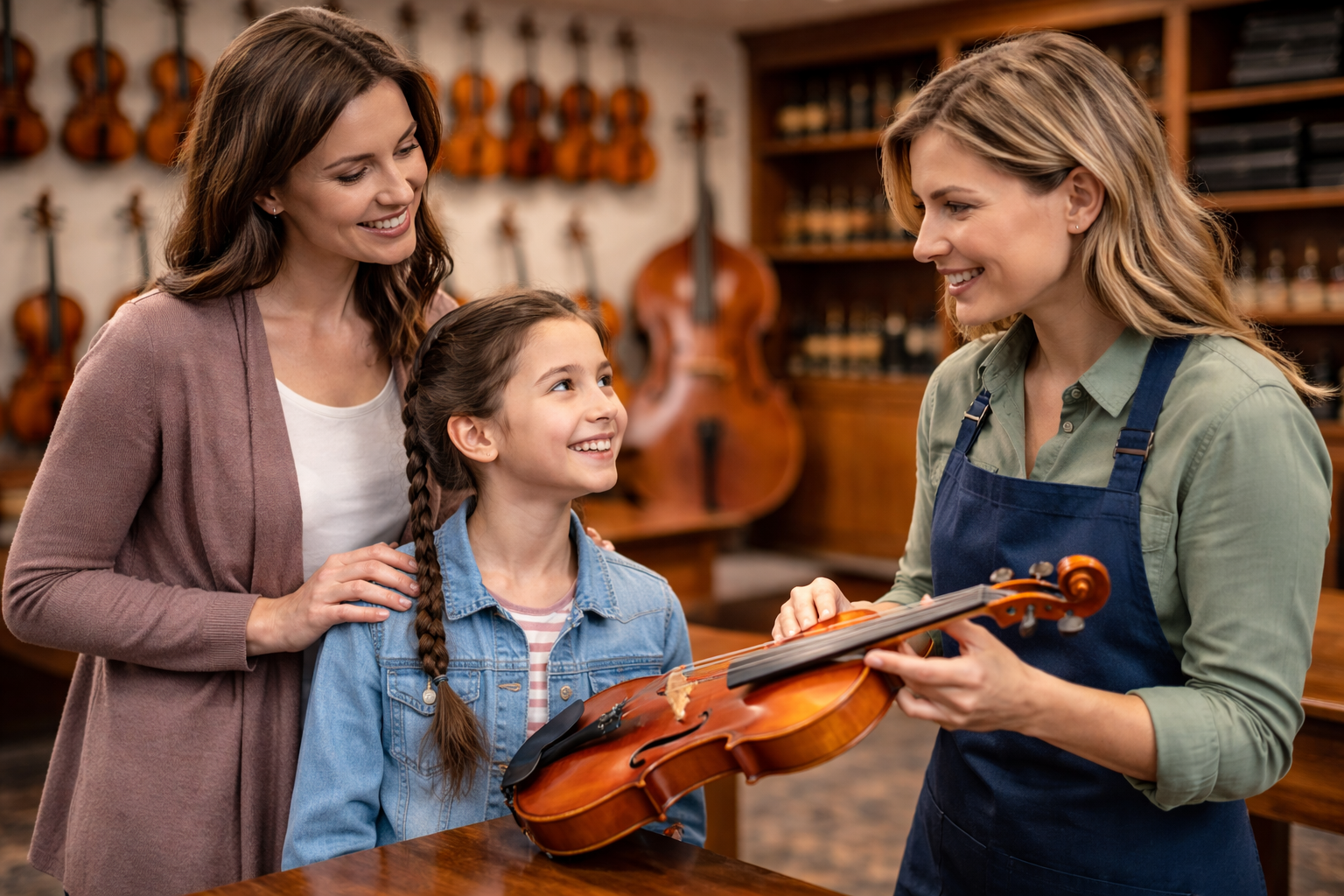
When a child shows interest in orchestra, one of the first questions parents ask is also one of the hardest to answer: Which instrument should my child start on?
It’s a reasonable concern. Most parents didn’t grow up playing orchestral strings, and many are unfamiliar with how violins, violas, cellos, and basses differ—or how children typically begin. The good news is that there is no single “right” answer, and there is far more flexibility than many families expect.
At Northland Violins and Von’s Violin Shop, we work with families whose children are starting orchestra. This is typically in elementary and middle school, as well as students who begin through private lessons. Our goal is to help parents understand the options clearly so their child can start on an instrument that fits both their interest and their physical needs.
Interest Matters More Than Student Size
One thing is absolutely certain: you cannot force a child to play an instrument they don’t want to play. Motivation plays a huge role in whether a student enjoys orchestra and sticks with it. A child who is excited about their instrument is far more likely to practice, participate, and progress.
While teachers may offer guidance or suggestions, the final choice always involves the family and the student. That choice should take the child’s interest seriously. If a child is strongly drawn to a particular instrument, that enthusiasm should be part of the decision. If little Suzy wants to play bass, she can. With instrument sizes down to as small as 1/8th regular size, almost any student can play any instrument they are called to.
Why Violin and Viola Are the Most Common Starting Instruments
Most beginning students start on violin or viola, and there are practical reasons for this. These instruments are widely used in school programs, available in many sizes, and easy to adapt as a child grows. Because they are smaller and lighter, they are often more manageable for younger students.
The violin is usually the most familiar instrument. Many children recognize it, and its role in orchestra is well established. The viola is very similar to the violin in how it is played, but it is slightly larger and produces a deeper, warmer sound. For students who like the idea of a richer tone, viola can be an excellent choice.
Violin and viola share the same basic playing technique. A student who learns viola can transition to violin, and vice versa, with a little effort, making either a flexible starting point. Basically the viola has the same strings as a violin except the high E is removed and replaced with a low C. The Violin has G, D, A and E strings, where the viola has C, G, D and A strings.
Understanding Cello and Double Bass as Starting Options
While violin and viola are the most common, cello and double bass are absolutely valid starting instruments for children who are drawn to them.
The cello while large, has the same exact strings as the viola. The cello uses the same tuning relationships as the viola, just lower, and produces a deeper, more resonant sound. Importantly, if a student can play viola, they can play cello. The left-hand logic and musical concepts transfer directly.
The double bass is the largest of the string instruments, but size alone should not rule it out. Fractional basses exist, just like fractional violins, violas and cellos. With sizes as small as 1/8 available, most children can be fitted with an instrument that works for their height and reach. Bass can be a wonderful choice for students who enjoy low sounds and strong rhythmic roles in music.
Physical Size and Fit Are Important—but Flexible
Parents often worry that their child is “too small” to start a particular instrument. In reality, modern fractional sizing makes it possible to find an instrument that fits almost any child. Violins, violas, cellos, and basses all come in a range of sizes designed for growing students.
That said, physical comfort does matter. An instrument should feel manageable, not overwhelming. At Northland Violins, proper sizing is part of the rental process, and instruments can be exchanged as a child grows. We will make sure your student walks out with an instrument that is sized for them. This flexibility removes much of the pressure from the initial decision.
Why Renting Is the Best Way to Start
For most families, renting is the best way for a child to begin. Renting allows students to try an instrument without committing to ownership before they know whether orchestra will become a long-term activity. It also makes size changes simple and stress-free as children grow.
Because Northland Violins specializes in instrument rentals, our rental program is designed specifically for students. Rental instruments are properly sized, professionally prepared, and come with everything needed to start playing right away. This approach lets families focus on learning and enjoyment instead of logistics.
Renting also gives families time to see how a child connects with their instrument. If a student later decides to switch instruments or move toward ownership, those decisions can be made with confidence and experience. In fact, each month’s rental gives credit toward purchase of the instrument.
One last advantage of renting, is insurance. For just $5 a month more, the instrument is fully covered. No matter what might happen (and somehow it usually does) your student’s instrument is fully covered for repair. No extra cost!
The Role of Teachers and Private Instructors
If a child is already enrolled in a school orchestra program or taking private lessons, the teacher should be part of the conversation. Teachers can offer insight into how an instrument choice might fit the program and the student’s strengths.
That said, teachers and violin shops play complementary roles. Teachers understand musical development and classroom needs, while Northland Violins focuses on proper sizing, instrument fit, and making sure students leave with equipment that works exactly as expected.
Making the Decision Feel Less Overwhelming
Choosing a first instrument doesn’t need to feel intimidating. The most important factors are the child’s interest, a comfortable physical fit, and starting with a rental that allows flexibility. There is no irreversible choice being made. Many students switch instruments later, and that is perfectly normal.
What matters most is starting with an instrument that encourages curiosity and enjoyment.
Learn More or Get Started
If you’re unsure which instrument your child should start on, we’re here to help. You’re welcome to learn more, call us, email us, or come in to talk through the options in person. We’re happy to answer questions, help with sizing, and explain how renting works so you can make a decision with confidence.
Starting orchestra should feel exciting, not stressful. At Northland Violins, that’s exactly what we aim to support.