
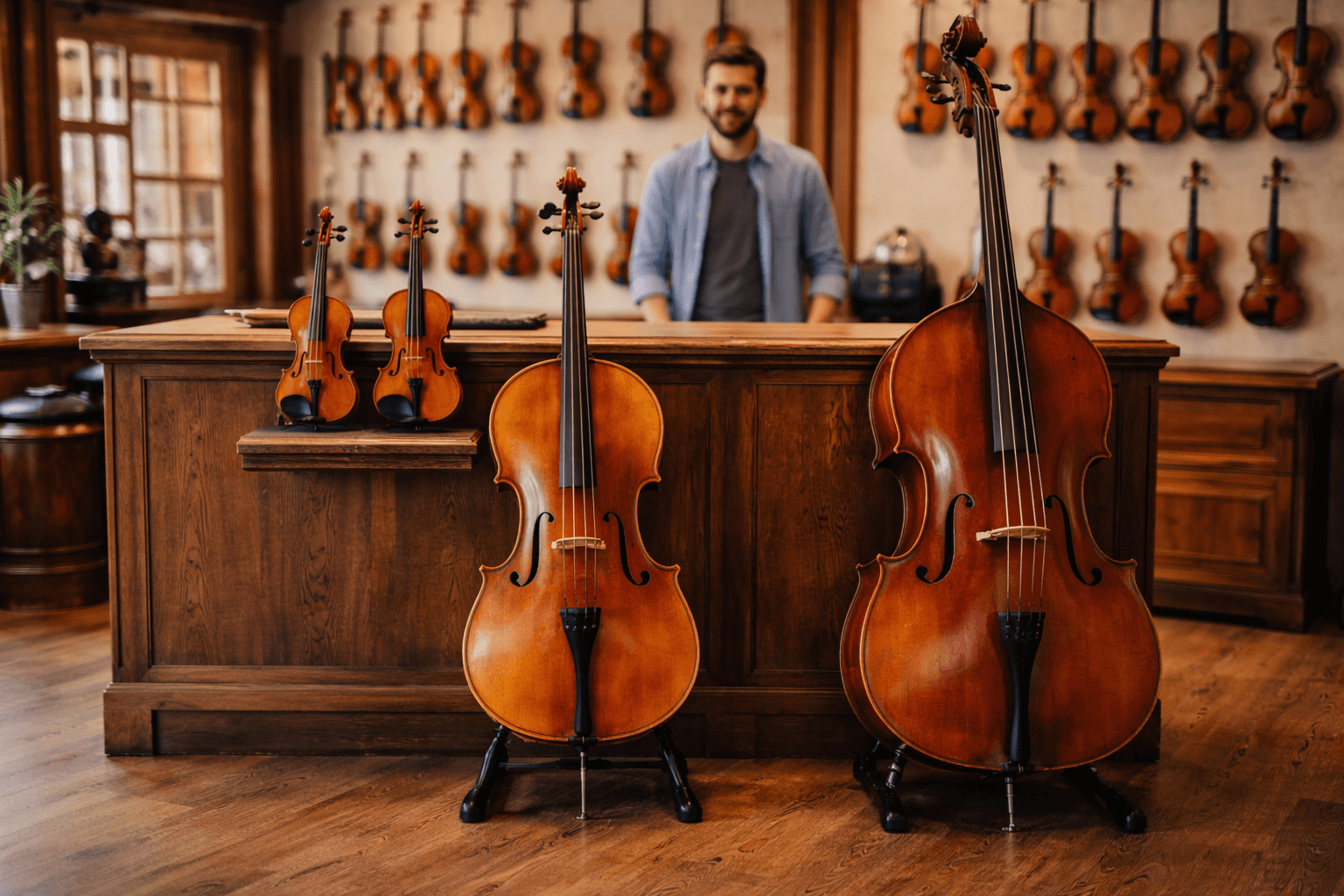
When a child shows interest in joining a school orchestra or starting private lessons, one of the first questions parents face is deceptively simple: Which instrument should my child play? The world of orchestral string instruments can feel unfamiliar at first, especially if you did not play yourself growing up. Violins, violas, cellos, and basses may all look similar to an untrained eye, but they differ in size, sound, musical role, and physical demands.
Understanding the basic differences between these four instruments can help parents feel more confident as they begin the process of choosing the right fit for their student.
The Violin: Smallest and Highest Sound
The violin is the smallest and most common orchestral string instrument. It produces the highest pitched sound in the string family and often carries the melody in orchestral and ensemble music. Because of its size and versatility, the violin is frequently the first instrument students encounter in school programs.
Violins are held under the chin and played with a bow. They are available in many fractional sizes, allowing even very young students to play comfortably. For parents, this means that physical size is rarely a limiting factor when choosing violin.
Musically, the violin tends to stand out. Its bright, clear sound is easily heard, which can be encouraging for beginners. Students who enjoy being heard and playing prominent musical lines often gravitate toward violin.
The Viola: Slightly Larger, Deeper Sound
At first glance, the viola looks very much like a violin. It is slightly larger, with a deeper body and thicker strings, which give it a warmer, darker sound. The viola plays lower notes than the violin and often fills in the inner harmonies of an ensemble.
One important difference for parents to understand is that the viola uses a different musical clef than the violin. While this does not affect beginners immediately, it is part of what gives the viola its unique role in orchestral music.
Physically, the viola is still held under the chin, like a violin, but it requires a bit more reach. Many students who enjoy a richer, less piercing sound prefer the viola once they have tried it. Because of its supportive musical role, viola players are often in high demand in school and youth orchestras.
The Cello: Larger, Played Seated
The cello is a noticeable step up in size. It is played seated, with the instrument resting on the floor between the player’s knees and supported by an extendable endpin. The cello produces a warm, resonant sound that sits in the middle to lower range of the orchestra.
For parents, one helpful way to think about the cello is that it shares much of the same musical range as the human voice. This makes it especially appealing to students who like expressive, lyrical music.
Unlike violin and viola, the cello is not held under the chin, which some students find more comfortable. The left hand positions are larger, and the bow arm uses more natural weight rather than fine wrist motion. Students who enjoy a grounded, physical connection to the instrument often feel drawn to cello.
The Bass: Largest and Lowest Sound
The double bass, often simply called the bass, is the largest and lowest sounding member of the string family. It provides the foundation of the orchestra, anchoring rhythm and harmony. Because of its size, the bass is usually played standing or on a tall stool.
Bass strings are thicker, and the spacing between notes is wider. This makes the instrument physically different from the others, but not necessarily harder. In fact, many students enjoy the bass because of its powerful presence and essential role.
Bass players are often in high demand, and students who choose bass frequently find many opportunities to play in ensembles. Despite its size, basses are available in student-appropriate fractional sizes, making them accessible even for younger players.
How These Differences Matter for Parents
From a parent’s perspective, the main differences between violin, viola, cello, and bass come down to three things: size, sound, and role in the group.
Violins and violas are smaller and portable, while cellos and basses are larger and require more space. Violins sound bright and high, violas warm and middle, cellos rich and full, and basses deep and grounding. In an ensemble, violins often carry melody, violas support harmony, cellos bridge melody and bass, and basses provide the foundation.
None of these instruments is inherently better or more difficult than the others. Each serves a different purpose, and each can be an excellent choice depending on the student’s interests, physical comfort, and musical personality.
A Starting Point, Not a Final Decision
For parents whose child is just beginning, understanding these differences is a starting point. It helps frame conversations with teachers and gives context to what the student may be drawn toward. Ultimately, the best instrument is one that the student feels excited to play and comfortable holding.
Northland Violins and Von’s Violin Shop work with families every day who are navigating these questions for the first time. By understanding the basic differences between violin, viola, cello, and bass, parents can approach the process with confidence and clarity, knowing that there is no single “right” choice, only the right fit for their student.